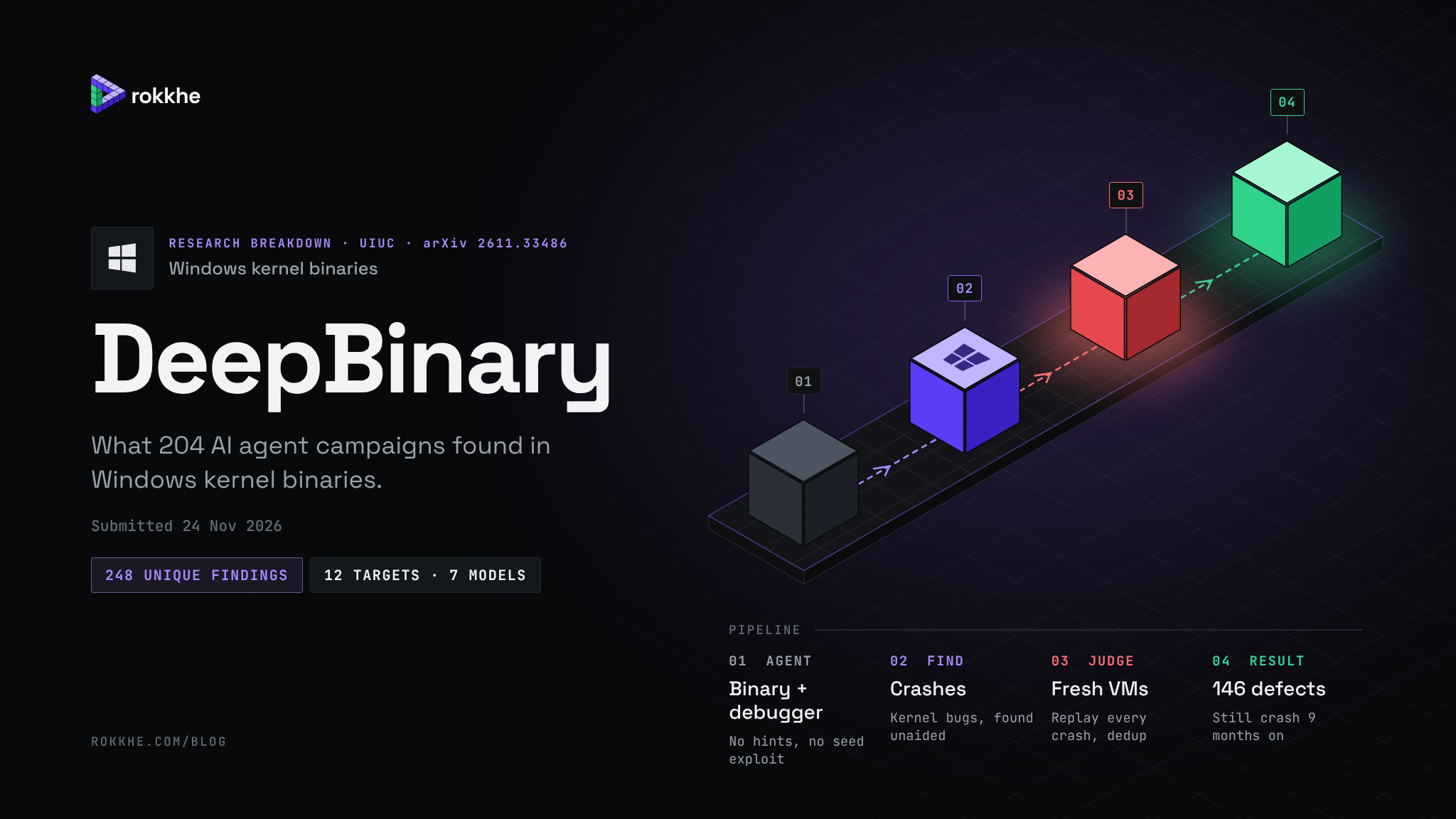
A new University of Illinois preprint gave AI coding agents a Windows kernel driver, a disassembler and a debugger, with no hint of where the bugs are. We read the full paper and put the method, the numbers, the limits and the lessons for defenders and pentesters in one place. Every figure is quoted from the paper, and where it is our opinion, we say so. Checked 28 November 2026, Asia/Dhaka. By the Rokkhe research team.
TL;DR
- What. Benchmarking Open-Ended Vulnerability Discovery in Windows Kernel Binaries by Jongseong Kim, Hwiwon Lee, Dongjun Kim and Lingming Zhang (University of Illinois Urbana-Champaign) introduces DeepBinary, a test of how well AI agents find unknown bugs in closed-source Windows kernel components. It is an arXiv preprint submitted 24 November 2026 (arXiv:2611.33486).
- Setup. Seven model and agent pairs, 12 kernel targets on one Windows 11 build, 204 campaigns, 4,119 agent-hours and $53.5K of token cost. Every crash an agent claims is replayed on fresh virtual machines (VMs) by a separate Judge before it counts (paper, §1 and §2).
- Result. In the main comparison the agents produced 248 findings that the paper counts as unique within each model, with an estimated bounty value of $661,000. Across all experiments, 146 distinct defects still crashed a Windows build released nine months later, which the authors call 0-days as of that build.
- Catch. Most of those 0-days are information disclosure or denial of service. Of the 64 findings classed as remote code execution or privilege escalation in the main comparison, 10 still crashed the newer build. A crash is not an exploit, and the paper does not claim otherwise.
- For you. Defenders should treat file-parsing kernel code as the first place AI-assisted attackers will look, and keep monthly updates flowing. Pentesters and anyone building an AI offensive tool can borrow the paper's best idea: do not trust an agent's claim until a separate step reproduces it.
Why this paper matters
Most public AI security benchmarks hand the agent something. A CVE description, a patch, the source code, a sanitizer harness, or the name of the file where the bug lives. That measures whether an agent can reproduce or exploit a known flaw. It does not measure the job a real attacker or a real tester does first: look at a big unfamiliar binary and decide where to dig.
The authors say none of the existing benchmarks they surveyed "evaluates agents on finding unknown bugs in closed-source binaries with no hint of where they lie" (paper, §1). Closed-source matters because much security-critical software ships only as binaries. A Windows kernel driver that parses files, system calls or network traffic from an unprivileged user is a good example. A memory-safety bug there can let that user gain kernel privileges.
DeepBinary is the authors' attempt to measure that open-ended job in a way that does not need a human to grade every report. The part that will interest anyone running offensive AI is how they grade, not only what the agents found.
How DeepBinary works, in plain terms
There are three parts: a way to date the answers, a harness that runs the agents, and a Judge that checks the claims.
 Windows build (Dec 2025)         Monthly updates (Jan to Sep 2026)
        |                                   |
        |                          WinDiffer: diff before/after,
        |                          date each fix  --> 228 known 1-days
        v
  +---------------------------------------------+
  | Agent (Codex, Claude Code or Grok Build)    |
  | goal: "find ALL valid, unique crashes"      |
  | tools: disassembler, read-only kernel       |
  | debugger, run PoC on a VM, no internet      |
  +---------------------+-----------------------+
                        | BUG-NNN/ (PoC, root-cause note, callstack)
                        v
  +---------------------------------------------+
  | Judge, separate from the agent              |
  | 1. replay on 4 fresh VM pairs               |
  | 2. one LLM call: valid? duplicate? impact?  |
  | 3. replay on a Sept 2026 build: still there?|
  +---------------------------------------------+
The targets. Twelve Windows kernel components that ship with the OS and work on a default install: file system drivers (ntfs.sys, refs.sys, spaceport.sys, clfs.sys, cldflt.sys, vhdmp.sys), local kernel interfaces (ntoskrnl.exe, win32k.sys, clipsp.sys) and the network stack (HTTP.sys, tcpip.sys, afd.sys). They cover the three ways untrusted input reaches the kernel: files and disk images, system calls, and network traffic. The test build is Windows 11 build 26100.7462, the 9 December 2025 cumulative update (paper, §2.2 and §4.1).
The agent's job. The prompt names only the target binary and build and asks for every valid, unique crash. There is no entry point, no vulnerability class, no earlier report and no seed proof of concept (PoC). The agent can disassemble, inspect the kernel with read-only debugger commands, write and compile programs on the target VM and run them as a standard user, craft disk images and attach them, and restart the VM as often as it likes. Each claimed bug is saved as a folder with a PoC, a root-cause write-up and a call stack (paper, §2.3 and §2.4).
No cheating by lookup. Each campaign runs in a network sandbox. The agent's container has no network interface, the only outbound path is HTTPS to the model provider's API, and the agents' own web search tools are turned off. The authors write that "Every bug a model finds thus comes from its own analysis of the binary and its prior knowledge" (paper, §4.1).
The Judge. This is the core of the design. The Judge is a pipeline that is separate from the agent:
- It rebuilds each PoC with the report's own scripts and runs it as a standard user on four fresh VM pairs. Two pairs run with Driver Verifier, a Windows tool that bugchecks as soon as a driver does something illegal. Two run without it, because Verifier changes timing and memory layout that some crashes depend on.
- A runner outside the agent's reach records every bugcheck and call stack. The paper's rule: "A report thus counts only if the Judge observes its crash itself" (paper, §2.5).
- One LLM call, with no tools, reads the root-cause note and the replay evidence, and returns a JSON verdict on validity, duplicate status and impact. It never sees the PoC source or the agent's trajectory.
Duplicates by root cause, not by stack hash. Fuzzers usually deduplicate by call stack. The authors argue that a stack can split one bug into several reports or merge different bugs that crash in a shared copy routine. So two reports are duplicates only if one minimal fix would block both triggers.
A price tag for severity. Each unique bug is put in one of four classes and valued at the maximum general award of the Windows Insider Preview Bounty for that class: remote code execution (RCE) $5,000, elevation of privilege (EoP) $8,000, information disclosure (ID) $2,000, denial of service (DoS) $500. The paper notes these are program maximums used for scoring, "not by what MSRC has paid or would pay" (paper, §2.5 and §4.1). One EoP bug counts as 16 DoS bugs.
Dating the answers. To check whether a model might simply remember a public fix, the authors built WinDiffer, a patch-diffing system that dates fixes from monthly updates. It produced a dataset of 228 known "1-day" bugs in the test build, each with the date its fix became public.
Key results
All numbers below are from the paper. "Unique" means unique within the reporting model, so a bug found by two models counts once for each.
1. The models differ a lot
In the main comparison (84 campaigns, 3 million output tokens each) the seven model and agent pairs submitted 334 reports. After the Judge and human review, 248 were unique, 28 were valid duplicates and 58 were hard fails, which gives 74% precision overall (paper, §4.2).
| Model (agent) | Reports | Unique | Precision | Est. bounty | Token cost | Cost per unique bug |
|---|---|---|---|---|---|---|
| GPT-6 Sol (Codex) | 138 | 116 | 84% | $296,500 | $4,318 | $37 |
| Claude Opus 5 (Claude Code) | 65 | 56 | 86% | $160,000 | $9,788 | $175 |
| Grok 4.7 (Grok Build) | 42 | 25 | 60% | $57,500 | $4,120 | $165 |
| DeepSeek V4.1 Flash (Codex) | 24 | 19 | 79% | $68,000 | $208 | $11 |
| Kimi K3 (Codex) | 32 | 15 | 47% | $30,000 | $2,478 | $165 |
| GLM 5.3 (Codex) | 26 | 13 | 50% | $38,000 | $5,020 | $386 |
| GPT-6 Luna (Codex) | 7 | 4 | 57% | $11,000 | $92 | $23 |
| All | 334 | 248 | 74% | $661,000 | $26,023 | $105 |
Three details are worth more than the leaderboard:
- Open-weight models trail the flagships, but not on cost. The three open-weight models found 13 to 19 unique bugs each, against 25 to 116 for the closed-weight flagships. Yet DeepSeek's 19 bugs carry a higher estimated bounty than Grok's 25 ($68,000 against $57,500) at about a twentieth of the discovery cost. Its bugs were 47% RCE or EoP, against 20% for Grok.
- Stamina separates the leaders. Sol found 51 unique bugs in its first million output tokens per campaign, for $1.5K. In the last million it found 43 more, nearly double the 22 it found in the million before. Grok found 18, 6 and 1 across its three million-token intervals, while its precision fell from 100% to 50% to 8%. DeepSeek found 10, 7 and 2.
- Same budget, very different habits. Sol and GLM made similar numbers of VM runs (13.3K and 12.6K) but recorded 431 and 76 kernel crashes. Sol ran 2.4 times as many experiments as Opus, with 2.7K output tokens per VM run against 6.5K.
2. Reading the right function is not the same as noticing the bug
The 248 findings point to 154 distinct root functions. Across models, 47% to 89% of those functions had been inspected by a given model, yet each model had only looked at 9% to 27% of a target's functions on average. The number of unique bugs found had a Spearman correlation of -0.04 with the number of distinct functions inspected, and +0.29 with the number of VM runs (paper, §4.2).
The striking result is in the 0-day analysis. For 77 of the 110 model-level 0-day findings, another model had already inspected the same root function and never reported a unique bug in it. In one case, all six other models inspected the function within their first 58K output tokens. GLM reported the defect after about 600K (paper, §4.5).
In plain terms, the models often looked straight at the bug and moved on. That is a practical argument for second-opinion passes over the same code.
3. File-parsing drivers produced most of the bugs
Three disk-image parsers (ntfs.sys, refs.sys and spaceport.sys) account for 186 of the 248 unique bugs, which is 75%, and 105 of the 154 root functions. Among functions that at least one model inspected, unique reports named 33 root functions per 1,000 in those parsers and 3.2 per 1,000 elsewhere. Out-of-bounds reads were 54% of findings in the parsers and 16% in the other targets. The kernel crash rate for Sol and Opus in the parsers was 7.4 and 9.3 per 100 VM runs, against 0.8 and 1.5 elsewhere (paper, §4.2).
The authors model an attached attacker-crafted disk image as "a user who opens an attacker's disk image or inserts an attacker's USB drive" (paper, §2.4).
4. Tools change the outcome
Using only Sol, with 2 million output tokens per campaign, the authors changed the tooling (paper, §4.3):
- Disassembler. Mean unique bugs per run were 70 with Ghidra, 85 with IDA Pro (+22%) and 87 with Binary Ninja (+24%). The authors are careful to note that the 95% bootstrap intervals for those ratios (0.97 to 1.93 and 0.98 to 2.00) include 1. One reason they give: for functions all three tools decompiled fully, Ghidra named the structure field in 2% of fixed-offset memory accesses, against 14% for IDA Pro and 9% for Binary Ninja.
- No symbols. 44 unique bugs per run, 37% below the Ghidra mean (interval 0.46 to 0.96). The drop was in filesystem drivers.
- No disassembler server. 23 unique bugs per run, 67% below (interval 0.17 to 0.43). Six of 12 campaigns found nothing. The median time to the first report rose from 160K to 651K output tokens.
Run-to-run variation for Sol with each disassembler was at most 21% of the mean.
5. The Judge is good, with one known weak spot
The authors tested the Judge against known answers (paper, §4.4):
- Replay. Of 334 reports, 276 were accepted. For 186 of the 248 unique findings the representative PoC crashed the kernel in all four replays, and for the other 62 it crashed in one to three. Picking a single random replay would reproduce about 89% of accepted reports. Rejections: 12 missing a required file, 21 build failures, 24 with no verified crash, and one where the crash came before the operation named as its cause.
- Rejecting wrong explanations. The authors paired 30 real crashes with deliberately wrong root-cause analyses. Single-shot GPT-6 Sol rejected all of them in all 270 queries. Claude Opus 5 accepted the wrong analysis in four queries.
- Duplicates. It grouped all 48 reproductions of ten patched defects correctly. Grouping the same reproductions by call stack would have produced 20 groups.
- Impact. Against vendor impact labels for 30 public reports, single-shot Sol matched 95.2% of queries and Opus 94.8%. An agentic Judge with Ghidra access matched 92.6% while using about 49 times as many input tokens. All 47 wrong answers called an EoP bug an ID bug.
Human review still changed 10 verdicts in the main comparison and 54 in the second experiment, nearly all on impact classes or duplicate links.
6. How many bugs were really new
The main evaluation used the December 2025 build. The authors replayed every PoC on the September 2026 cumulative update (build 26100.9457), nine months newer. In the main comparison, 110 of the 248 findings (44%) still crashed it. In the tooling experiment, 324 of 792 (41%) did. After merging duplicates across models and runs, that is 146 distinct defects. Only 16 of the 70 distinct defects in the main comparison were found by more than one model (paper, §4.5).
The severity split matters. On the September build, PoCs still reproduced for 6 of 38 RCE findings, 4 of 26 EoP findings, 50 of 114 ID findings and 50 of 70 DoS findings. For 48 of the 54 RCE and EoP findings that no longer crashed, an update had repaired the reported defect itself. The paper states that "Most of RQ1's 110 model-level 0-day findings are ID or DoS."
7. Did the models just remember public fixes?
The authors checked. Using each model's training cutoff or weights release date, at most 27 of 248 findings (11%) could reflect exposure to a public update. They add that "Their dates alone cannot establish whether a model learned from a fix." Of the 228 known 1-days, 171 shipped from July to September, after every published cutoff. The model-stratified odds ratio for a match after versus before the cutoff was 0.92 (95% CI 0.46 to 1.83). The main evaluation also found only 58 of the 228 known 1-days (paper, §4.5).
That last number is a useful correction to the headline. The agents found a lot, and still missed most of what Microsoft fixed in the same components over the same period.
What defenders should do
The paper is a benchmark, not a defender's guide, and it does not list recommendations. What follows is our reading, not the authors' advice.
- Keep monthly updates flowing for kernel code. More than 40% of the agents' findings still crashed a build nine months newer. Most were ID or DoS, but the yield suggests agents will keep surfacing more. Shortening the time between a fix shipping and the fix being installed is the one lever fully in your hands.
- Rank parser exposure first. In this test, disk-image parsers produced three quarters of the bugs. Treat anything that mounts, previews or indexes files from outside your trust boundary as higher risk: removable media policy, file previews on servers, virtual disk handling, and storage features you do not use. Disable what you do not need.
- Do not count on obscurity. Removing symbols cut Sol's yield by 37% in this test, but Microsoft publishes symbols for Windows binaries, and taking away the decompiler server cut yield by 67%, not to zero. Hiding information slows an agent. It does not stop one.
- Test your own drivers the way the Judge does. If you ship kernel or driver code, run Driver Verifier with special pool in test, and fuzz parsers with crafted images. The paper shows why: memory corruption surfaces immediately under special pool instead of corrupting memory silently.
- Expect a faster discovery cycle. The authors describe campaigns of "most of a day" per target. Agents found real, reproducible bugs in code that has shipped for years, with no hints. Plan on more bugs being found, and sooner.
What it means for pentesting and AI offensive security
This is where we think the paper is most useful, and it is about method more than raw counts.
- Verification belongs outside the agent. The Judge replays every claim on clean machines and trusts only its own crash record. That is the same principle as a good pentest report: a finding without a reproducible proof is a lead. At Rokkhe the rule we work to is prove first, report second, and retest after the fix.
- Deduplicate by cause. A tool that counts stack hashes will inflate or deflate its own results. Root-cause grouping, even by an LLM, matched human review much better.
- Agent quality is a systems problem. The model mattered, and so did the disassembler, the symbols, the budget and the harness. Sol's lead kept growing in the final million tokens while others flattened, so a short trial of an AI testing tool can rank it wrongly.
- Stamina and precision both matter. The models that kept submitting reports after they ran out of real findings lost precision fast (Grok's fell to 8% in its last interval). A tool that reports more is not a tool that finds more.
- Run second looks. In 77 of 110 cases, another model had already read the same function and said nothing. Cheap second-opinion passes over high-value code are an obvious thing to try.
- Be honest about severity. A crash is not an exploit. Only 10 of the 64 RCE and EoP findings survived to the newer build, and the paper's bounty column is an estimate. Customers deserve the same candor in a pentest report.
None of this tells you how an agent would do on a web app, an API or a cloud account. DeepBinary is about native Windows kernel code. The design ideas transfer. The numbers do not.
Limitations
The authors list these themselves, and we add the ones we noticed (paper, §5).
- One kernel, one build. Twelve Windows targets on one build. The counts describe Windows only.
- One campaign per model and target. Cost prevented repeats. Counts range from 4 to 116 across the seven models. For Sol, run-to-run variation per disassembler was at most 21% of the mean. For the other models, it is unknown.
- An LLM grades the results. The Judge uses GPT-6 Sol, which also reports the most unique bugs. The authors tested Claude Opus 5 as an alternative Judge and it agreed on all round verdicts except one false acceptance. They built the invalid reports in the Judge test themselves, so real agent errors may differ. Their duplicate test does not cover distinct defects with similar crashes.
- Scoring is an estimate. Bounties are a scoring device, not payouts.
- No strategy in the prompt. Telling agents to prioritise RCE or EoP could change both counts and severity.
- Funding and access. The authors thank OpenAI's Daybreak for Frontline Defenders grant for supporting the experiments. The benchmark's evaluation framework is not publicly distributed, according to the project's GitHub page, so outside groups cannot rerun it today. A public leaderboard is linked there.
- Preprint. It is arXiv v1 with no venue listed when we checked, so it has not been through peer review as far as we can tell.
- Disclosure. We did not find a statement in the paper on how the 0-day findings were reported to Microsoft. The project page says sensitive findings should go through coordinated disclosure with the affected vendor.
- Not published. The paper does not publish the PoCs. This post does not try to reconstruct any.
FAQ
Did AI agents really find 146 new Windows vulnerabilities? The paper reports 146 distinct defects whose PoCs still crashed a September 2026 Windows build, nine months after the test build. The authors call these 0-days as of that build. They are crashes verified by replay with a debugger trace, and most are information disclosure or denial of service. The paper does not say how many are exploitable.
Is this about Windows being weak? No. The paper measures agents, and Windows was the chosen target because it is a large, closed-source, widely deployed kernel. The authors say a port to another kernel would need its own VM image, debugger bridge and impact table. Nothing here ranks Windows against any other system.
Which model was best? In this one setup, GPT-6 Sol in the Codex agent found the most (116 unique bugs). Claude Opus 5 had the highest precision (86%). DeepSeek V4.1 Flash had the lowest cost per unique bug ($11). The authors ran one campaign per model and target, so small gaps should not be read as rankings.
Can I use DeepBinary to test my own driver? Not directly. The evaluation framework is not public. The ideas are portable, though: a sandboxed VM pair, a read-only debugger, replay on fresh machines and root-cause deduplication.
Does this mean AI will replace human vulnerability researchers? The paper does not argue that. It shows long-running agents find real, reproducible crashes without guidance, and that they miss a lot: only 58 of 228 known fixes in the same components matched. Humans still choose targets, judge severity and write exploits that matter.
Do I need to do anything today? If you run Windows, install current updates as usual. If you build kernel components, look at parsers first. There is no emergency here, and no CVE to patch because of this paper.
Where Rokkhe helps
We did not do this research. Jongseong Kim, Hwiwon Lee, Dongjun Kim and Lingming Zhang did, and every number above is theirs. Our contribution is the plain-language read and what we take from it for our own work.
Scope to retest, in one loop. Rokkhe's AI pentesting starts from the assets you run, tests them with authorization, and does not call something a finding until it reproduces. After you fix it, we retest the same scope.
Proof before report. We aim to hand over each finding with steps a person can replay and a severity we can defend.
Defense in the same loop. The same engagement can feed detection back into the test plan, so offense and the SOC are not two separate projects.
Book an evaluation
If you want a second pair of eyes on what an AI-assisted attacker would reach first in your environment, book an evaluation at rokkhe.com. More briefings and guides are at rokkhe.com/blog.
Sources
About the author
- Incubated at SEMIA (Strasbourg).
Comments
Join the discussionNo comments yet. Be the first to comment.