
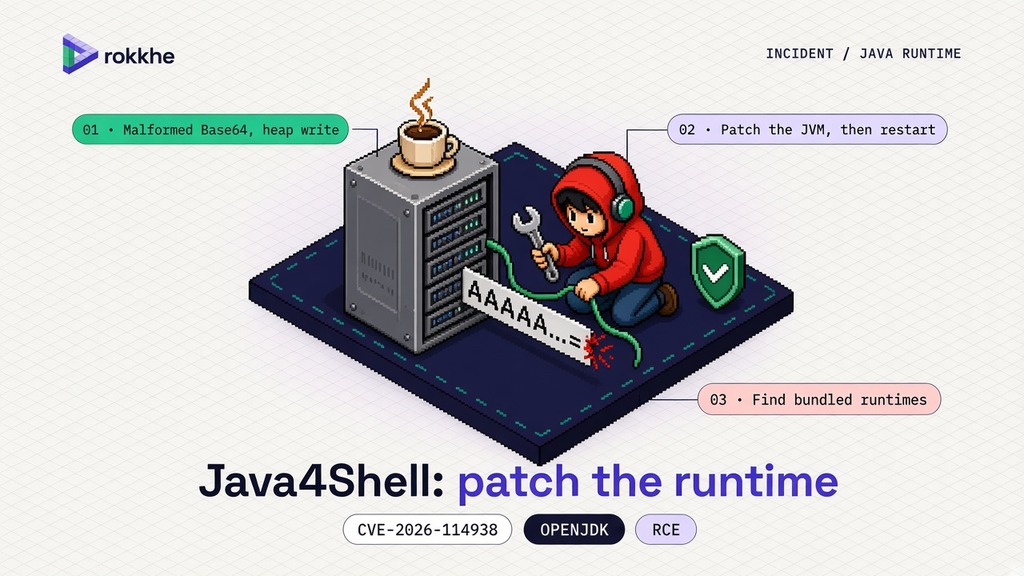
What is known about Java4Shell (CVE-2026-114938) as of 18 Nov 2026, from 30+ public sources. By the Rokkhe research team.
On 17 November 2026, Calif disclosed Java4Shell, tracked as CVE-2026-114938: a memory corruption bug in the fast Base64 decoder inside OpenJDK, the code that almost every Java runtime is built from (Calif). The same day, Oracle shipped fixed builds in its November 2026 Critical Security Patch Update (Oracle CSPU), the OpenJDK Vulnerability Group published its advisory (OpenJDK), and CISA told organisations to patch immediately (CISA).
If you run Java 17 or later on recent Intel or AMD servers, this post is for you. We read the researcher write-up, the vendor and government advisories, the security vendor analyses, the news coverage and the discussion on X and Hacker News, and put it in one place. Every claim links to where it came from. Where sources disagree, we say so. The short version: find every Java runtime you run, including the ones bundled inside other products, patch it, restart it, and use a JVM flag as a stopgap where you cannot patch today.
Credit first: the bug was found and reported by Quang Luong of Calif, with exploit work by Jenish Rakholiya (Calif). Oracle also credits Albert Yang (Tenable).
What happened
- 17 Nov, about 16:00 UTC. Calif posted on X that details had leaked ahead of the fix, confirmed it had found and reported the bug, and said full details would follow after Oracle's patch (Calif on X). SecurityWeek also reports that news of the flaw surfaced before the coordinated disclosure (SecurityWeek).
- 17 Nov, 1:00 pm Pacific (21:00 UTC). Oracle released its patch and OpenJDK released its advisory (Calif). Oracle's update covered 655 patches across its products, and Java4Shell is one of 11 Java SE fixes in it (The Register, Tenable).
- 17 Nov, 21:11 UTC. Calif published its write-up, "Write once, RCE everywhere" (Calif on X).
- 17 and 18 Nov. CISA, the Canadian Centre for Cyber Security, CERT-EU, Singapore's CSA and Belgium's CCB issued alerts (CISA, Cyber Centre, CERT-EU, CSA Singapore, CCB). Red Hat opened bulletin RHSB-2026-018 (Red Hat).
One detail worth knowing: The Hacker News reports that an input which triggers the overflow was posted publicly on 9 September in a proposed fix to OpenJDK's code repository, and that the pull request was closed without merging in early November after going inactive (The Hacker News).
How it works, in plain terms
Base64 turns binary data into text. Java apps decode it all the time: login headers, tokens, SAML messages, file uploads. To do that faster, HotSpot (the JVM inside OpenJDK) swaps the normal Java decoder for a hand-written assembly routine on x86-64 chips that support AVX-512 VBMI (Calif, Datadog Security Labs).
That routine mishandles a stray = at the end of the input. Its length maths goes negative, a negative length turns into a full 64-byte masked write, and the CPU writes about 62 bytes past the end of the output array (Calif, Datadog). Calif says the input that triggers it can be as simple as 64 A characters followed by one = (128 on older Java 17 builds) (Calif).
Java then rejects the input with an IllegalArgumentException, but the damage is already done. Catching the exception does not undo it, and the crash can show up much later, for example during garbage collection (Datadog, Rapid7).
Two more details matter for defenders:
- It only fires once the decoder is "warm". The fast routine is used only after the JIT compiler has compiled the hot decode path (Datadog, Element Security).
- The bytes written are mostly fixed, not chosen. Calif turned that limited write into a heap read it calls "JavaBleed" (secrets, keys and tokens in memory) and then into code execution, using per-target heap grooming (Calif, SecurityWeek).
Rapid7 describes the fix as handing final groups shorter than four bytes to the ordinary Java decoder (Rapid7).
Who is affected
All of these have to be true at once (Red Hat, CERT-EU):
- An affected Java build. OpenJDK 17.0.6 and later on the 17 line, plus 21, 25 and 27 before the fixed builds (Calif, OpenJDK). Standard Java 8 and 11 do not contain the code (Red Hat). The exception is Oracle's Java SE 8 Enterprise Performance Pack build 8u511b33-perf, which Oracle lists as affected, along with GraalVM for JDK and GraalVM Enterprise (Tenable). Every OpenJDK-based distribution is in scope: Oracle, Temurin, Corretto, Zulu, Microsoft, Liberica, SapMachine, Red Hat (Calif).
- An x86-64 CPU with AVX-512 VBMI. That means Intel Xeon Ice Lake, Sapphire Rapids, Emerald Rapids and Granite Rapids, and AMD Zen 4 or newer. On Linux,
/proc/cpuinfomust list all four ofavx512f,avx512bw,avx512vbmiandbmi2(Calif). ARM64 is not affected, so Graviton and other native ARM JVMs are out of scope (Datadog). - The JVM is using the AVX-512 path. This is the default on supported CPUs. It is off if the JVM runs with
-XX:UseAVX=2or lower (Red Hat). - Attacker-controlled Base64 reaches
java.util.Base64.Decoder. HTTP Basic credentials, SAML artifacts, CSRF tokens, JWTs, cookies and MIME encoded words are common paths, and many are decoded before login (Red Hat, CERT-EU). Datadog found that the basic and URL decoders use the vulnerable path but the MIME decoder fromgetMimeDecoder()does not, so libraries that decode Base64 themselves may behave differently (Datadog).
A practical point from The Hacker News: because exposure depends on the chip, the same container image can be vulnerable on one node and not on the next (The Hacker News). Qualys adds that a workload on a safe CPU today can land on an affected one after a resize, so use the CPU check to order your work, not to close findings (Qualys).
Products Calif reports exploiting in default configurations (Calif):
- Before login: Keycloak, Atlassian Jira, Atlassian Confluence, JFrog Artifactory, Jenkins and PingFederate.
- After login: Apache Kafka Broker, Apache Solr, Elasticsearch, Gerrit and Spinnaker.
- Also: sample apps built on Apache Struts and Spring Boot.
Calif says both lists are incomplete. These products are not buggy themselves. They are exposed only when they run on an affected Java build on an affected CPU (CCB). Wiz says it also showed remote exploitation against Jenkins, Confluence and Apache Tomcat (Wiz). Kevin Breen of Immersive says Tomcat's Basic auth and the java-jwt library give pre-login paths (KevTheHermit on X). Element Security says it confirmed by decompiling that Jira decodes the Authorization: Basic header on every request before authentication (Element Security).
The client side. Calif says researcher samczsun shared an exploit in which a Java program that opens a TLS connection to a malicious server can be compromised, even if it exposes no service at all (Calif). How that path reaches the decoder has not been published (The Hacker News). Belgium's CCB reads this as putting workstations at risk too (CCB). So build agents, schedulers, crawlers and anything else that calls out to the internet from Java count as well.
Exploitation status as of 18 November 2026
- In the wild: no confirmed exploitation reported by Cisco Talos, GreyNoise, Tenable, Sophos or the Canadian Cyber Centre (Talos, GreyNoise on X, Tenable, Sophos, Cyber Centre). Talos expects probing to pick up soon. GreyNoise runs a live tracking dashboard for it (GreyNoise).
- CISA KEV: not listed when Aikido and The Hacker News checked (Aikido, The Hacker News).
- Public code: Calif's public proof of concept triggers the corruption but does not run code. It is holding back its per-product chains until people have had time to upgrade (Calif). Kevin Breen and VulnCheck each say they built working exploits, and both stress that every exploit has to be tailored to its target (KevTheHermit on X, SecurityWeek).
- Crashing is easy, code execution is not. Crashing an affected JVM is trivial and repeated requests can keep it down (Help Net Security, quoting VulnCheck). Blackpoint Cyber crashed a test Spring Boot app before login with about 28,300 malformed login requests in roughly 20 seconds (The Hacker News). Code execution needs heap grooming plus a separate leak to beat ASLR (Help Net Security). Calif also notes its network attack is sensitive to round-trip time and jitter (Hacker News thread, quoting Calif's write-up).
How fast was this found? Calif says Quang Luong found the bug in about an hour with AI help and had a first working exploit two hours later, for under $200 in tokens (Calif). BleepingComputer reports the tool used was OpenAI's Codex (BleepingComputer). Wiz says its own AI research harness built a proof-of-concept exploit within two hours, before full details were out (Wiz).
That speed matters to us. It is also why we wrote about detecting and containing machine-speed intrusions earlier this week.
Where the sources disagree
- Severity. Calif scores it 9.2 (Critical, CVSS 4.0). Oracle scores it 8.1 (High, CVSS 3.1) with high attack complexity (Tenable). The Hacker News reports Red Hat's preliminary score as 9.8 and Amazon's as 8.8 (The Hacker News). Atlassian rates it 9.2 for its Data Center products (Atlassian). CISA calls it critical, while CERT-EU and Singapore's CSA call it high severity.
- How bad in practice. Calif demonstrated remote code execution. Datadog says denial of service is the more readily achievable impact (Datadog). Some sources say independent researchers have so far reproduced crashes and memory leaks but not code execution (CCB, The Hacker News). Meanwhile VulnCheck and Kevin Breen say they built working exploits (SecurityWeek, KevTheHermit on X). VulnCheck and watchTowr expect targeted rather than mass exploitation (Help Net Security, watchTowr on X). Kevin Beaumont put it as "not world ending. Just patch" (Help Net Security). On Hacker News, commenters split on whether AI tooling will shorten the gap to reliable exploits (Hacker News thread).
- Which CPUs. Belgium's CCB includes Intel client chips from 2019 to 2021 (Ice Lake, Tiger Lake, Rocket Lake) (CCB). Element Security says consumer Intel desktops are not affected (Element Security). Do not trust a model list. Check the four CPU flags on the actual host.
- Workaround status. Calif, Red Hat, Datadog and others publish JVM flags. Tenable and Sophos note that neither Oracle's nor OpenJDK's advisory mentions them, and Sophos says it has not validated them (Tenable, Sophos). CERT-EU writes the Base64 flag with
-XX:+UnlockDiagnosticVMOptionsin front, while most others do not (CERT-EU). Test on your own build. - Input-size limits. CISA lists input-size limits as a temporary control (CISA). Qualys points out that the malformed input is very short, so size limits alone will not stop it (Qualys).
How to find your exposure
CISA's warning is the one to plan around: Java runtimes "may not appear as separate entries in software inventories" (CISA). The JDK you need to patch is often not the one on your shell's PATH.
1. Check the CPU on each x86-64 host or node pool.
grep -m1 '^flags' /proc/cpuinfo | tr ' ' '\n' | grep -E '^(avx512f|avx512bw|avx512vbmi|bmi2)$'
All four flags must appear (Calif). In the cloud, check every instance type you use, not just one.
2. Check the runtime each process actually uses. The java -version command on the host is a start (Red Hat). For a running service, ask the process itself, as Datadog suggests:
jcmd <PID> VM.version
jcmd <PID> VM.flags -all | grep -E 'UseBASE64Intrinsics|UseAVX'
(Datadog)
Read the full build string. Element Security warns that version strings are easy to misread here, and that 17.0.21 alone does not tell you whether you have the fix (Element Security). Oracle's fixed Java 17 build is 17.0.21.1, and Oracle's vulnerable build is 17.0.21.0.3 (Rapid7).
3. Look inside containers. Patching the host leaves the JDK inside an image untouched. Rebuild and redeploy (Hadrian, Datadog). A quick check against an image you run:
docker run --rm --entrypoint java <image> -version
If your registry or scanner produces SBOMs, search them for OpenJDK, Temurin, Corretto, Zulu and similar packages at the affected versions. Qualys published a version-range query for its own asset tool that you can copy as a starting point for whatever you use (Qualys).
4. Find bundled runtimes in vendor products. Many products ship their own JRE. Atlassian Data Center is one example: Atlassian says its fixed releases will follow once Temurin ships a fix (Atlassian). Adoptium has now announced the fixed Temurin builds, so watch for Atlassian's updates (Adoptium). An admin in that thread warns that running apt upgrade on the host does not patch the bundled JRE. CERT-EU's rule of thumb: products that include their own Java runtime stay affected until their vendor ships an update (CERT-EU).
5. Do not forget build infrastructure. Calif's list includes Jenkins, Artifactory, Gerrit and Spinnaker (Calif). Qualys notes that build and artifact servers sign and ship your software (Qualys). Atlassian's guidance covers Bamboo remote, elastic and ephemeral agents separately (Atlassian). Our own reading, not from a source: CI workers, long-lived Gradle daemons, Android build images and Java-based tools on developer laptops are easy to miss. Add them to the list, because the client-side TLS path means they do not need to expose a port to matter. The same goes for pinning the tools your pipelines pull in, which we covered in pinning GitHub Actions by SHA.
6. Prioritise. CISA, CERT-EU, Rapid7 and Qualys all say to start with internet-facing systems. Qualys gives a sensible order (Qualys):
- Identity providers.
- Jira, Confluence, Jenkins and Artifactory.
- Other Java services that handle logins, tokens or uploads.
- Internal systems.
If you want a repeatable way to run this kind of triage every week, see our post on weekly CVE triage with KEV, EPSS and CVSS.
Fixes
Install the fixed build from your runtime's vendor, then restart every JVM. A patch or a flag only takes effect after a restart (CERT-EU, Qualys).
| Runtime | Fixed build | Status as of 18 Nov |
|---|---|---|
| Oracle Java SE 17 / 21 / 25 / 27 | 17.0.21.1, 21.0.13.1, 25.0.5.1, 27.0.1.1 | Released 17 Nov (Datadog, Rapid7) |
| Oracle Java SE 8 Performance Pack | 8u513-perf | Released (Rapid7) |
| Oracle GraalVM for JDK 17 / 21, GraalVM EE | 17.0.21.1, 21.0.13.1, EE 21.3.20.1 | Released (Rapid7, The Hacker News) |
| Amazon Corretto 17 / 21 / 25 / 27 | 17.0.21.1.2, 21.0.13.1.2, 25.0.5.1.2, 27.0.1.1.4 | Released (Amazon Linux, Censys) |
| Azul Zulu 17 / 21 / 25 / 27 | 17.70.201, 21.54.201, 25.38.201, 27.30.201 | Released (The Hacker News) |
| SAP SapMachine | 17.0.21.1, 21.0.13.1, 25.0.5.1, 27.0.1.1 | Released, release pages do not say what they fix (The Hacker News) |
| Red Hat (RHEL 8/9/10, Red Hat build of OpenJDK) | Pending | Red Hat is expediting fixes (Red Hat) |
| Eclipse Temurin 17 / 21 / 25 / 27 | 17.0.21.1+2, 21.0.13.1+2, 25.0.5.1+2, 27.0.1.1+4 | Rolling out. Adoptium says binaries are published as testing completes, and Docker Hub images follow once all binaries for a version are out (Adoptium) |
| Microsoft Build of OpenJDK | Pending | Download page still lists 17.0.21.0.2 and 21.0.13.0.2 (Microsoft) |
| BellSoft Liberica | Pending | No fixed build listed when checked (The Hacker News) |
| Debian | Fixed in sid only | bookworm and trixie packages still marked vulnerable (Debian tracker) |
| Ubuntu | Pending | The openjdk-21 package accepted into noble-security this month is 21.0.13.0.3, a build Oracle lists as affected (Ubuntu noble-changes) |
Distribution packages move fast this week, so re-check your vendor's page before you act on this table. If you run Temurin, check the full build string: the fixed builds end in .1 (for example 17.0.21.1+2), while 17.0.21+9 is the vulnerable October build (Adoptium, Hadrian). Adoptium recommends -XX:-UseBASE64Intrinsics until you can upgrade (Adoptium). If the official eclipse-temurin image for your version is not updated yet, some vendors publish their own patched base images. Aikido lists several on a public registry (Aikido). Treat any third-party image like any other dependency and verify where it comes from.
After the fix:
- Containers: rebuild the image on the fixed base, then redeploy. Red Hat says the same for images built on UBI (Red Hat).
- Secrets: Belgium's CCB suggests rotating keys and tokens held by internet-facing Java apps that ran an affected build on affected hardware, because JavaBleed can read memory (CCB). We agree, starting with identity providers and CI.
Stopgap if you cannot patch today
Two JVM startup options stop the vulnerable path (Calif, Datadog):
-XX:-UseBASE64Intrinsicsturns off only the fast Base64 code. Datadog calls it the narrower workaround, and Red Hat and Qualys list it as the preferred option (Red Hat). Aikido and Qualys warn that apps which decode a lot of Base64 may run slower (Aikido, Qualys).-XX:UseAVX=2turns off all AVX-512 use, so the performance cost is broader. Use it on x86-64 only. A native ARM64 JVM does not recognise the flag and will not start, so keep it out of shared startup settings (Datadog, JFrog). Atlassian's guidance pairs it with-XX:+IgnoreUnrecognizedVMOptionsfor that reason (Atlassian).
Upwind, quoted by The Hacker News, found that both flags stopped the overflow in its tests. It also warns that -XX:DisableIntrinsic=_base64_decodeBlock on its own stops Java from starting (The Hacker News).
How to roll it out:
- Add the flag to the service's JVM options.
JAVA_TOOL_OPTIONSworks for containers. - Restart the service.
- Confirm it took effect on the running process, for example with
jcmd <PID> VM.flags -allshowingUseBASE64Intrinsics = false(Datadog). - Remove the flag once the fixed build is in.
Neither flag replaces the patch.
Other temporary controls:
- Take admin consoles off the internet. Put identity, build and collaboration consoles behind a VPN or take them off the internet until they are patched (Qualys, Wiz).
- WAF rules. Microsoft has published Azure WAF custom rules that block malformed Base64 in headers, the request body, the query string and the
Authorizationheader (Microsoft). Wiz warns that WAF rules cannot cover every path into the decoder (Wiz). - Reverse proxies. A proxy that buffers whole requests, as nginx does by default, blocks some attacks but not all (The Hacker News). Qualys says not to rely on one (Qualys).
Detection ideas
There are no public indicators of compromise for this yet, and none of the signals below proves an attack on its own. These are the signals sources have published:
- Network signatures. Cisco Talos released Snort rules: Snort 2 SIDs 1:67502 to 1:67513, and Snort 3 SID 1:301754 plus the same range. They look for malformed Base64 in specific HTTP request fields of known vulnerable apps. Some are enabled by default and some are not (Talos, Snort advisory).
- Malformed Base64 in requests. Upwind suggests watching for Base64 tokens of 32 or more characters that end in
=and whose length is not a multiple of 4, especially inAuthorizationheaders (The Hacker News). Microsoft's WAF regexes are a usable starting point for a log search too (Microsoft). - Application errors. Look for bursts of
IllegalArgumentExceptionfromjava.util.Base64$Decoder, unexplainedhs_err_pidcrash logs, and runs of JVM restarts (The Hacker News, CISA). Hadrian saw Spring Security and Tomcat Basic auth on Temurin 17.0.21+9 exit with code 134 and write a fatal error log (Hadrian). - Traffic shape. Element Security describes the exploit's traffic as periodic: bursts of well-formed decode requests to re-warm the JIT, then single malformed attempts, repeated. It also warns that a JVM can keep serving traffic after the overflow, so "still up" does not mean "not hit" (Element Security).
- After the fact. Watch for Java processes that start a shell or open outbound connections they have never made, and for Java runtimes your inventory does not know about (Qualys, CISA). Talos notes that Splunk's existing content covers web and app servers spawning shells (Talos).
Patching does not undo a past compromise (CCB). If an internet-facing instance ran exposed, review its logs before you close the ticket.
Where Rokkhe helps
We did not find this bug, and we are not going to tell you a product would have caught it. Calif did the hard work. What we can do is help you get through the week.
Inventory review. We go through your hosts, node pools, container images, SBOMs and vendor products with you and map every Java runtime to its build, its CPU and its exposure. That includes the bundled ones that do not show up in a package list.
Testing exposed Java services. For services you own and authorise us to test, Rokkhe's AI agents check whether attacker-controlled Base64 actually reaches the JDK decoder before login: Basic auth, SAML, JWTs, cookies and uploads. We then confirm the fix or the flag is live on the running process. We will not run public exploit chains against your production systems, and we will not guess. You get proof of what is reachable and what is closed.
Detection rules. Every exploit we prove becomes a detection rule in your SIEM. For this one, that means rules built from the signals above, tuned to your own logs so they do not drown your team. Our SOC can watch them with you while the vendor patches arrive.
Keeping your data where you want it. Rokkhe can run self-hosted, in the Paris region, with your own model key.
Book an evaluation
If you run Java in production and want a second pair of eyes on your exposure this week, book an evaluation at rokkhe.com. For the bigger picture on third-party risk, see our write-up of the Optimizely Web incident.
Sources
Researcher and project sources
- Calif, "Java4Shell: Write once, RCE everywhere": https://calif.io/java4shell/
- Calif on X (17 Nov): https://x.com/calif_io/status/2122724367654334810 and https://x.com/calif_io/status/2122799880221687837
- OpenJDK Vulnerability Advisory 2026/11/17: https://openjdk.org/groups/vulnerability/advisories/2026-11-17
- Oracle Critical Security Patch Update, November 2026: https://www.oracle.com/security-alerts/cspunov2026.html
- NVD entry: https://nvd.nist.gov/vuln/detail/cve-2026-114938
- oss-security post: https://www.openwall.com/lists/oss-security/2026/11/17/31
Government and CERT advisories
- CISA: https://www.cisa.gov/news-events/alerts/2026/11/17/critical-java-vulnerability-requires-immediate-patching
- Canadian Centre for Cyber Security AL26-029: https://www.cyber.gc.ca/en/alerts-advisories/al26-029-critical-vulnerability-impacting-oracle-java-cve-2026-114938
- CERT-EU Security Advisory 2026-021: https://cert.europa.eu/publications/security-advisories/2026-021/
- Cyber Security Agency of Singapore AL-2026-166: https://www.csa.gov.sg/alerts-and-advisories/alerts/al-2026-166/
- Centre for Cybersecurity Belgium: https://ccb.belgium.be/advisories/warning-memory-corruption-openjdk-and-oracle-java-se-can-be-exploited-take-over-java
Runtime and product vendors
- Red Hat RHSB-2026-018: https://access.redhat.com/security/vulnerabilities/RHSB-2026-018
- Amazon Linux / Corretto: https://explore.alas.aws.amazon.com/CVE-2026-114938.html
- Eclipse Adoptium, Temurin guidance for CVE-2026-114938: https://adoptium.net/news/2026/11/temurin-november-2026-cspu-java4shell
- Microsoft Build of OpenJDK downloads: https://learn.microsoft.com/en-us/java/openjdk/download
- Debian security tracker: https://security-tracker.debian.org/tracker/CVE-2026-114938
- Ubuntu noble-changes: https://lists.ubuntu.com/archives/noble-changes/2026-November/060664.html
- Atlassian, Data Center mitigations: https://community.atlassian.com/forums/discussion/3317765/data-center-mitigations-for-cve-2026-114938
- Microsoft, Azure WAF mitigations: https://techcommunity.microsoft.com/blog/azurenetworksecurityblog/addressing-java4shell-cve-2026-114938-upgrade-guidance-and-azure-waf-mitigations/4574305
- JFrog Security Research: https://research.jfrog.com/post/java4shell-vulnerability/
- Sophos advisory: https://www.sophos.com/en-us/security-advisories/sophos-sa-20261118-java4shell
Security research and vendor analysis
- Datadog Security Labs: https://securitylabs.datadoghq.com/articles/java4shell-remote-code-execution-in-openjdk-cve-2026-114938/
- Tenable FAQ: https://www.tenable.com/blog/java4shell-cve-2026-114938-frequently-asked-questions-about-openjdk-rce-vulnerability
- Cisco Talos: https://blog.talosintelligence.com/java4shell/ and Snort rules https://www.snort.org/advisories/talos-rules-2026-11-17-11-18-2026
- Wiz: https://www.wiz.io/blog/cve-2026-114938-rce-java4shell-openjdk
- Rapid7: https://www.rapid7.com/blog/post/etr-cve-2026-114938-reported-critical-pre-authentication-remote-code-execution-java-17/
- Qualys: https://blog.qualys.com/vulnerabilities-threat-research/2026/11/17/how-to-find-mitigate-and-patch-the-critical-java4shell-flaw-cve-2026-114938-now
- Censys: https://censys.com/advisory/cve-2026-114938/
- Aikido: https://www.aikido.dev/blog/java-17-rce-vulnerability-cve-2026-114938
- Element Security: https://element.security/java4shell-pre-auth-rce-in-openjdk-base64-cve-2026-114938/
- Hadrian: https://hadrian.io/vulnerability-alerts/oracle-critical-security-patch-update-java-17-rce-claims
- GreyNoise: https://x.com/GreyNoiseIO/status/2122851501899239809
News and discussion
- BleepingComputer: https://www.bleepingcomputer.com/news/security/critical-java4shell-flaw-allows-rce-attacks-on-major-java-applications/
- The Hacker News: https://thehackernews.com/2026/11/java4shell-cve-2026-114938-enables-pre.html
- SecurityWeek: https://www.securityweek.com/java4shell-vulnerability-puts-many-enterprise-applications-at-risk-of-takeover/
- Help Net Security: https://www.helpnetsecurity.com/2026/11/18/java4shell-openjdk-vulnerability-cve-2026-114938/
- The Register: https://www.theregister.com/security/2026/11/18/oracle-reveals-fix-this-asap-grade-java4shell-bug-that-allows-attacks-on-many-third-party-apps/5310661
- Kevin Breen (Immersive) on X: https://x.com/KevTheHermit/status/2122829165925998824
- watchTowr on X: https://x.com/watchtowrcyber/status/2122809209238528378
- Hacker News discussion: https://news.ycombinator.com/item?id=50538240
Rokkhe SAS is based in Strasbourg, France. This post reflects public sources as of 18 Nov 2026 (Asia/Dhaka) and will be updated as vendors ship fixes or exploitation is reported.
Disclosure: this post was drafted with AI assistance and reviewed and edited by the Rokkhe team. Every claim was checked against the linked public sources as of 18 Nov 2026.
Comments
Join the discussionNo comments yet. Be the first to comment.